In distributed systems, failures are loud.
You get a 500 Internal Server Error. An unhandled exception lighting up your dashboard. An out-of-memory crash with a stack trace that points, more or less, at the scene of the crime. Decades of tooling have been built on a simple assumption: when something breaks, it tells you.
Autonomous AI agents break that assumption.
One of the most maddening failure modes in production agent systems is the one where nothing appears to be wrong. The HTTP request returns 200 OK. The latency graphs show healthy activity. You were billed for inference tokens, so the model clearly ran. And yet the user receives an empty string, a dropped connection, or a silent fallback message. No error. No trace. No crime scene. Just silence.
I’ve started calling this the Muted Model — and it’s worth understanding, because it exposes a blind spot in how we monitor these systems.
Why traditional monitoring can’t see it
Here’s the thread that ties every muted-model failure together, and it’s the thing to internalize before we go suspect-hunting:
Every component reported success. The system still failed.
The HTTP layer returned 200. The model emitted tokens. The retriever ran its query. The router resolved its graph. Each individual piece did exactly what it was asked and logged a clean result — which is precisely why your dashboards stay green while your user stares at a blank screen.
The failure doesn’t live inside any component. It lives in the seams between them — the handoffs where one part’s “success” quietly becomes another part’s “nothing to do.” Traditional APM watches components. Muted-model failures happen in the gaps. That’s the whole mystery in one sentence, and it’s why you can’t debug this by staring at CPU and error-rate graphs.
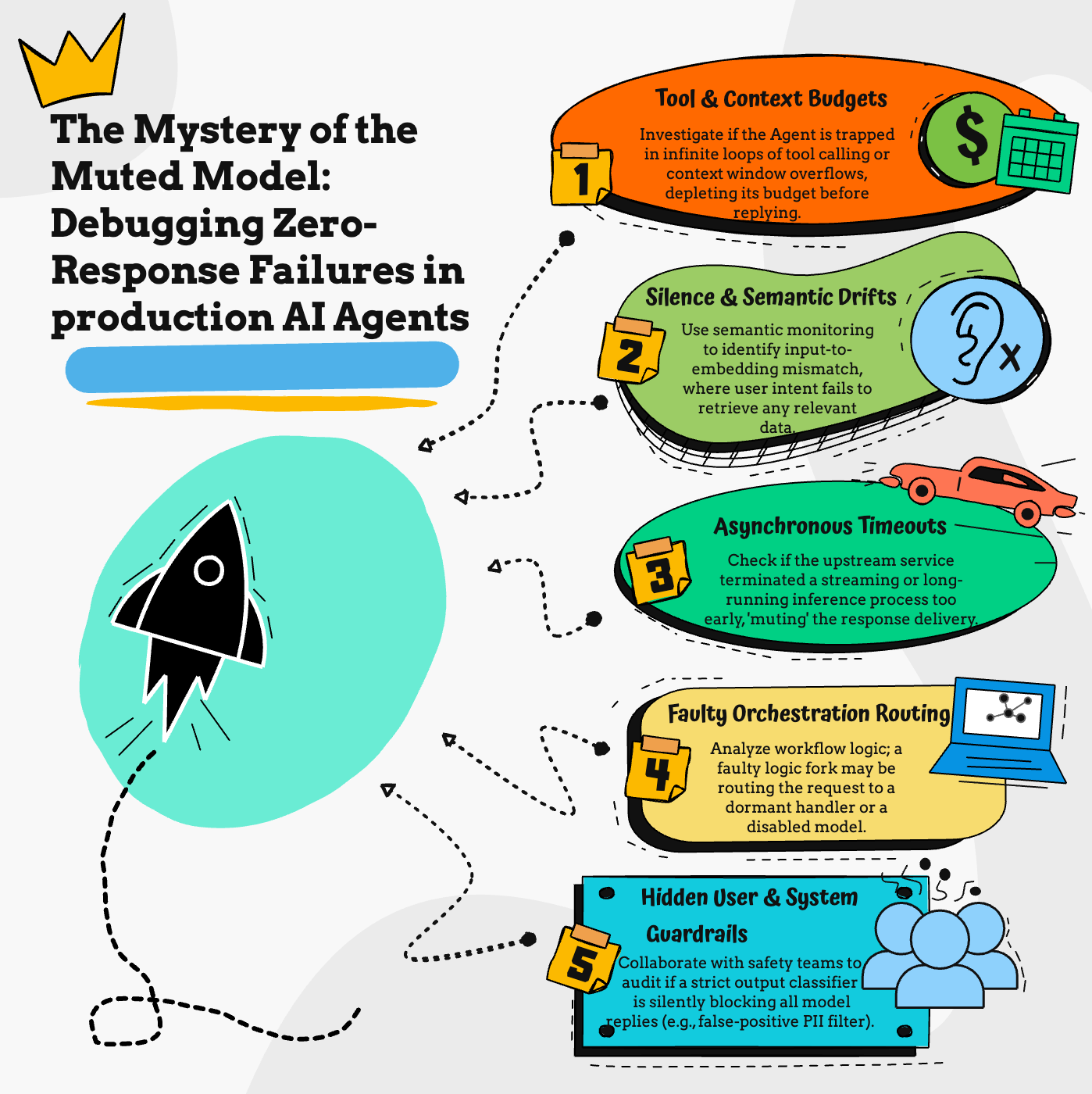
So let’s walk the five suspects.
Suspect 1: The Runaway Loop
Agents don’t just answer — they reason in a loop: think, act with a tool, observe the result, think again. It’s the mechanism that makes an agent an agent. It’s also the mechanism that can quietly eat itself alive.
Picture an ambiguous query and a tool that returns messy, unstructured output. The agent calls the tool. The result doesn’t cleanly resolve its reasoning step. So it tries again, slightly differently — appending the full raw tool output to its running history each time.
[Prompt] → [Thought] → [Tool Call] → [Messy Result]
              ▲                            │
              └────── try again ◄──────────┘
Each lap inflates the context. Eventually the accumulated history slams into the model’s context window or a hard token cap — and the inference engine truncates the payload or terminates without ever emitting a final answer. You paid for every one of those laps. The user got nothing.
The fix is two-fold. First, cap the loop: enforce a hard ceiling on tool iterations per session (three to five is a sane starting point) at the orchestrator level, so a confused agent can’t spiral forever. Second — and this is the one people skip — never feed raw tool output back into the model. Put a summarization step in between that extracts only the key fields. Raw payloads are what bloat the context in the first place.
Suspect 2: The Silent Retriever
Retrieval systems fail politely. That’s the problem.
When a user asks something out-of-domain, heavy on jargon, or spanning multiple intents, a vector search may simply find nothing above its similarity threshold. It doesn’t error. It returns an empty list — a perfectly valid result that happens to be useless.
Now watch what a well-intentioned prompt template does with that emptiness:
“Answer strictly using ONLY the context below. If the context doesn’t contain the answer, do not guess.”
The retriever handed over nothing. So the model, following instructions perfectly, produces… nothing. An empty completion. You built a guardrail against hallucination and accidentally built a mute button.
The fix: stop trusting the retriever blindly. Add a programmatic check before you call the model — if zero chunks came back, don’t invoke inference at all; branch into a clarifying question instead (“Could you tell me more about X?”). And broaden what “relevant” means: pair dense vector search with old-fashioned keyword search so a lexical match can rescue a query the embeddings missed.
Suspect 3: The Dropped Connection
This one isn’t the model’s fault at all — it’s the plumbing.
Modern agents stream their answers token by token over long-lived connections. That exposes them to a network race condition most people get wrong, so let me be precise about the mechanism, because the common explanation is off.
A reverse proxy like NGINX doesn’t cut your connection because the total response took too long. It cuts it because too much time passed between reads — a silent gap. NGINX’s default here is 60 seconds, not the few seconds people often assume. But here’s the catch with agents: if your agent spends that whole time silently grinding through several synchronous tool calls before it emits its first token, the proxy sees a long silence and closes the socket. The client gets a connection-closed signal with no payload attached.
The fix falls right out of the mechanism. Since it’s silence that kills the connection, break the silence. Emit lightweight heartbeat events while long tools run — a ping, or better, a status frame like {"status": "searching database"}. Any byte down the pipe resets the timer (and the status text is genuinely nice UX). For anything truly long-running, decouple the tool execution from the response stream entirely using a background task queue.
Suspect 4: The Dead-End Router
As agent systems grow up, simple prompt chains get replaced by routers — a classifier looks at the request and dispatches it to the right specialist agent.
                  ┌──► SQL Agent      ──► results
[Router] ─────────┼──► Document Agent  ──► summary
                  └──► (unmatched)     ──► ...nothing
The silent failure is almost embarrassing in its simplicity. The classifier emits Data_Query when the router expects data_query. The string doesn’t match any branch. Execution falls through to a default path that has no actual generation step wired to it. The graph resolves “successfully” with an empty result object, everyone logs green, and the user hears crickets.
The fix: treat routing outputs as untrusted input, because they are. Enforce a strict schema (an enum, validated) on every classification step so a case-mismatched string can’t sail through. And never leave a default branch empty — every router needs an explicit catch-all node that logs the unrouted request and returns a real, human-readable fallback message.
Suspect 5: The Overzealous Guard
Enterprise deployments wrap the model in safety layers — PII masking, content moderation, prompt-injection defense. Necessary work. But these classifiers have false positives, and a benign query can trip one.
The trouble is what many default implementations do when a guardrail fires: they suppress the model’s output and return an empty payload — without mapping that block to any user-facing error code. The moderation layer did its job and logged a clean 200. The user just… got nothing, with no idea why.
The fix: make the block observable and make it honest. Every moderation interception should emit its own metric with a reason tag (guardrail.blocked = true, reason = pii_filter) so it shows up on a dashboard instead of hiding inside a 200. And replace the silent drop with a real message: “This request couldn’t be processed due to an automated data-privacy check.” A blocked response is fine. A silent blocked response is a support ticket you’ll never be able to reproduce.
The detective’s checklist
When an agent goes quiet, the culprit is almost always one of the five above — and each leaves a distinct fingerprint if you know which trace to pull:
- Budget: high token spend paired with zero completion tokens → you’re in a runaway loop.
- Retrieval: the returned-chunk count is zero or everything’s below your similarity floor → the silent retriever.
- Transport: time-to-first-token is creeping up toward your proxy’s read timeout → a dropped connection waiting to happen.
- Routing: the state machine keeps terminating in a default or unhandled node → a dead-end router.
- Governance: the safety layer is returning 200s with empty bodies → an overzealous guard.
Notice the pattern in that list. Not one of these shows up as an error. Every single one hides inside a signal that says “success.” That’s the real lesson of the muted model: the systems we’re building now can fail while every component swears everything is fine.
The old world trained us to watch for things that break loudly. Agents demand a new instinct — watching the silences, and the seams between the parts, where the loud “success” of each piece adds up to a quiet failure of the whole.
Debug the gaps, not just the boxes.