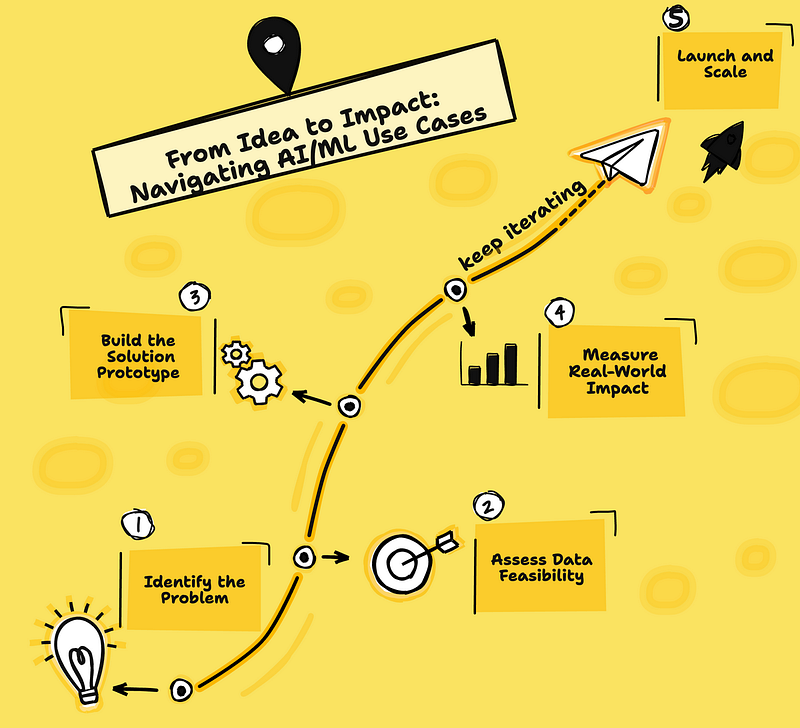
A visual roadmap for taking your AI/ML use case from concept to scalable impact.
Every impactful AI/ML solution begins with a simple question: What problem are we solving? But getting from a raw idea to a real-world deployment is rarely linear. This blog offers a visual guide to help you chart the journey — one step at a time.
Section-by-Section Breakdown
1. Identify the Problem
Start with the why. Focus on business value, not just technical feasibility.
What’s the pain point? Who’s affected? What outcome would mean success?
2. Assess Data Feasibility
Before jumping into modeling, check if you have the right data.
Is it available, clean, unbiased, and sufficient? Do you need synthetic data, enrichment, or collection strategies?
3. Build the Solution Prototype
Start small. Use notebooks or low-code tools to test hypotheses.
Avoid over-engineering. Focus on quick feedback loops.
4. Measure Real-World Impact
Move beyond accuracy scores — evaluate value delivered.
Does it save time? Increase revenue? Improve user experience? This is where business alignment is validated.
5. Launch and Scale
When proven, productionize the solution with proper MLOps practices.
Think: CI/CD, model monitoring, retraining pipelines, and feedback collection.
Keep Iterating
No model is perfect forever — iterate based on results, user feedback, and changing data.
Closing Thoughts
AI/ML isn’t about models — it’s about meaningful impact. Following a structured path helps teams stay aligned, focused, and effective.
Whether you’re a data scientist, PM, or decision-maker, this framework helps demystify AI/ML development. Use it as a checklist or conversation starter in your next project.